0.1 Six Collinear Points
Six collinear points, also known as seven collinear points, is one of the fundamental topics to study in euclidean geometry for olympiads. I don’t think this topic is popular internationally, but I can assure that every Korean students preparing for KMO knows this diagram.
This diagram is quite special because seven points lie on the same line, and that is definitely not common. There are also many different ways to prove this, but let’s not use Pascal and other topics, but only foundational topics because it feels intuitive and more like an olympiad problem. But before proving, here is the diagram. Also, if you prefer video explanation over text, the video is available as well.
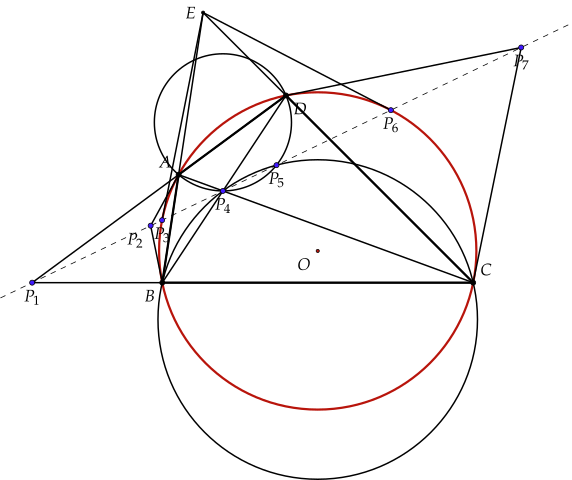
Here, quadrilateral \(ABCD\) is inscribed in the circle with center \(O\), and \(E\) and \(P_1\) are the points obtained by finding the intersection between \(AB\) and \(CD\) and intersection between \(AD\) and \(BC\) respectively. \(P_2\) and \(P_7\) are obtained by finding the intersection between the lines tangent to the circle with center \(O\) from \(A\) and \(B\) and \(C\) and \(D\) respectively. Finally, \(P_4\) is the intersection of \(AC\) and \(BD\) and \(P_5\) is the intersection of circumcircles of \(\triangle {P_4AD}\) and \(\triangle {P_4BC}\).
I know this sounds a lot at first, but it is actually quite easy to memorize and notice in problems involving cyclic quadrilaterals. Now let’s prove this thing!
Proof.
Consider the annotated diagram below.
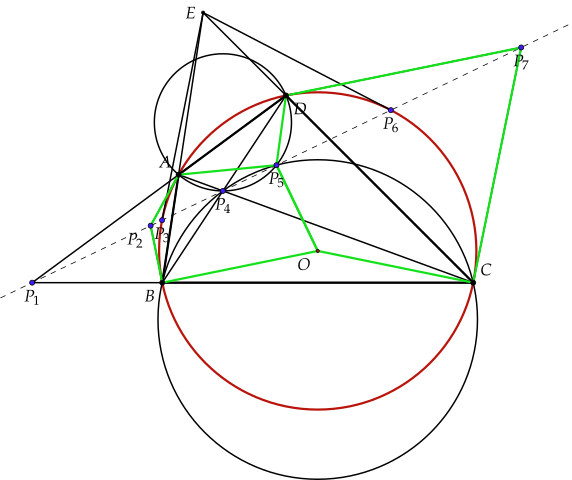
First, notice that \(P_1\) is the radical center of three circles. Therefore, \(P_1, P_4, P_5\) are collinear. Continuing, notice that quadrilaterals \(AP_2BO\) and \(DOCP_7\) are cyclic by construction. Moreover, the following equations hold. \begin{align*} \angle {AP_3B} &= \angle {AP_3P_4} + \angle {P_4P_3B} \\ &= \angle {ADB} + \angle {ABC} = \angle {AOB} \\ \angle {DP_5C} &= 360 - \angle {DP_5P_4} - \angle {P_4P_5C} \\ &= 180 - \angle {DP_5P_4} + 180 - \angle {P_4P_5C} \\ &= \angle {DAC} + \angle {DBC} = \angle {DOC} \end{align*}
Therefore, \((A P_2 B O P_5)\) and \((D P_5 O C P_7)\).
Continuing, consider the following equations. \begin{align*} \angle {P_4P_5O} &= \angle {P_4P_5B} + \angle {BP_5O} &= \angle {ACB} + \angle {BAO} = 90^\circ \end{align*}
Therefore, \(P_4P_5 \perp P_5O\) and \(E, P_5, O\) are collinear since \(E\) is the radical center of \(\omega _1, \omega _4, \omega _5\) where \(\omega _4\) and \(\omega _5\) are the circle that circumscribe the pentagons. Because \(OP_2\) and \(OP_7\) are the diameter of \(\omega _4\) and \(\omega _5\), \(P_1, P_2, P_4, P_5, P_7 \in l\).
Using power of a point theorem, notice that the following equations hold. \begin{align*} EP_3^2 &= ED \cdot EC = EP_5 \cdot EO \\ \therefore EP_3 : EO &= EP_5 : EP_3 \\ EP_6^2 &= EA \cdot EB = EP_5 \cdot EO \\ \therefore EP_6 : EO &= EP_5 : EP_6 \end{align*}
Therefore, \(\triangle {EP_5P_3} \sim \triangle {EP_3O}\) and \(\triangle {EP_5P_6} \sim \triangle {EP_6O}\). In other words, \(P_3P_5 \perp P_5O\) and \(P_6P_5 \perp P_5O\). Thus, the seven points are collinear.
This could look a lot, but when you think about it, you can observe this in most of the problems involving cyclic quadrilaterals. Many times, three or four of these seven points act as a breakthrough of the problems. Here is a quick example.
Exercise 0.1.1: 2020 KMO Problem 2
Given an acute triangle \(ABC\), let \(H\) and \(M\) be the orthocenter and the midpoint of \(BC\) respectively. Let \(D\) and \(E\) be the intersection between the circle with diameter \(AH\) and sides \(AB\) and \(AC\) respectively. Let \(P\) be the intersection of \(AH\) and \(DE\) and let \(Q\) be the intersection of \(DM\) and the line perpendicular to \(AH\) that passes through \(H\). Show that \(P, Q, B\) are collinear.
Solution.
First, consider the following diagram.
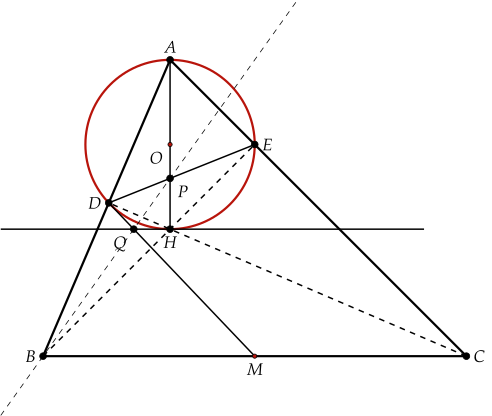
Looking at the diagram with respect to cyclic quadrilateral \(ADHE\), the six collinear points can be found. Consider the annotated diagram.
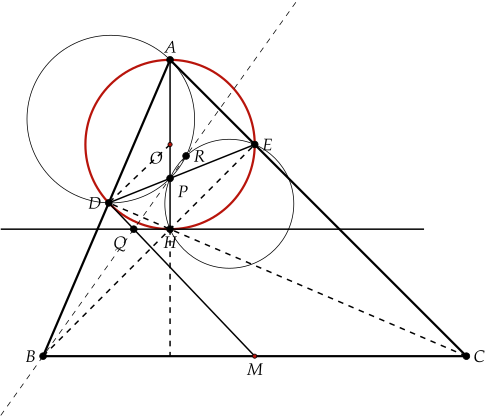
From here, notice that with \(\angle {ADH} = \alpha \), we have \(\alpha = \angle {DEH} = \angle {DHQ} = \angle {DCB}\). Moreover, \(\angle {DMB} = 2\alpha = \angle {DOH}\). In other words, \(OD \perp DM\) and \(B, P, Q\) are three of the seven points.
Continuing, consider the new point \(R\). Notice that because \(\angle {DRP} + \angle {PRH} = \angle {DAH} + \angle {DEH} = \angle {DOH}\), \((DORHQ)\). Moreover, notice that \(\angle {ORP} = \angle {ORD} + \angle {DRP} = \angle {OHD} + \angle {DAH} = 90^\circ \). Because \(\angle {QRO} = 90^\circ \), \(Q, P, R\) are collinear and \(B, Q, P, R\) are also collinear by radical axis. Therefore, \(P, Q, B\) are collinear.
This problem is now easy with six collinear points! There are many different ways to solve this problem such as using homothety and pole and polar, but I think this method is the most straightforward. This is it for this section! In the next section, we will discuss another very important topic isogonal conjugate.