rojective Geometry]
Note 1
[G] Projective Geometry
Projective geometry, unlike euclidean geometry, relies on the relationship between objects and their projections. One way I like to think about it is the study of shades. There are important topics that cannot be solved without prior knowledge, so let’s dive into it!
1.1 Foundations
Before we get into some important theorems and topics, lets discuss some of its foundational properties to get the gut feeling for future topics.
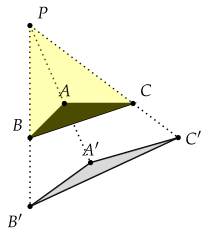
corresponding sides of \(\overline {AB}, \overline {BC}, \overline {CA}\) respectively.
1.1.1 Cross Ratio
Cross ratio is a very important topic that lays foundations to many contents that we are going to discuss from now so it is very important to fully understand them! First, consider the following diagram with four collinear points \(A, B, C, D\).

From the diagram above, we could define a new term.
The cross-ratio of \(A, B, C, D\) is defined as the following. \[ (A, B; C, D) = \frac {(x + y) (y + z)}{y (x + y + z)} \]
This is very important because if we project these points with respect to another line by a point say \(P\), then the cross ratio of the resulting points is the same as the original value. Consider the following diagram for an illustration.
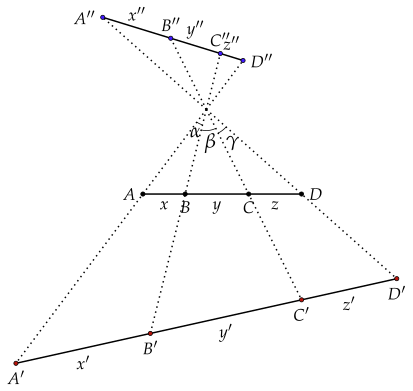
In this diagram, we can see that the following equation holds. \[ (A, B; C, D) = (A', B'; C', D') = (A'', B''; C'', D'') \] To prove this, let’s use length area ratio. Consider the following equations. \begin{align*} (A, B; C, D) &= \frac {(x + y)(y + z)}{y (x + y + z)} = \frac { [\triangle {PAC}] \cdot [\triangle {PBD}] } { [\triangle {PBC}] \cdot [\triangle {PAD}] } \\ &= \frac { PA \cdot PC \cdot \sin (\alpha + \beta ) \cdot PB \cdot PD \cdot \sin (\beta + \gamma ) }{ PB \cdot PC \cdot \sin \beta \cdot PA \cdot PD \cdot \sin (\alpha + \beta + \gamma ) } \\ &= \frac { \sin (\alpha + \beta ) \cdot \sin (\beta + \gamma ) } { \sin \beta \cdot \sin (\alpha + \beta + \gamma ) } \\ &= \frac { [\triangle {PA'C'}] \cdot [\triangle {PB'D'}] } { [\triangle {PB'C'}] \cdot [\triangle {PA'D'}] } = (A', B'; C', D') \end{align*}
The same argument applies for the top one, or you could just think of it as the rotated version.
Continuing with this, we can implement this idea to four points on a circle. I think this is one of the foundational topic that could act as the breakthrough.
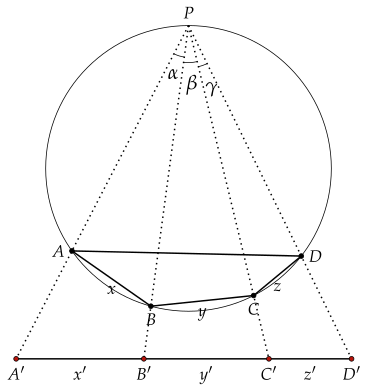
From this diagram, we will use the Law of Sines to show that \((A, B; C, D) = (A', B'; C', D')\). First, notice that \((A', B'; C', D') = \frac { \sin (\alpha + \beta ) \cdot \sin (\beta + \gamma ) }{ \sin \beta \cdot \sin (\alpha + \beta + \gamma ) }\) from our previous observation. Moreover, the following equations hold. \begin{align*} \frac { \sin (\alpha + \beta ) \cdot \sin (\beta + \gamma ) }{ \sin \beta \cdot \sin (\alpha + \beta + \gamma ) } &= \frac { \frac {\sin (\alpha + \beta )}{AC} \cdot \frac {\sin (\beta + \gamma )}{BD} }{ \frac {\sin \beta }{BC} \cdot \frac {\sin (\alpha + \beta + \gamma )}{AD} } \cdot \frac {AC \cdot BD}{BC \cdot AD} \\ &= \frac { \frac {\sin \angle {PDA}}{PA} \cdot \frac {\sin \angle {PAD}}{PD} }{ \frac {\sin \alpha }{AB} \cdot \frac {\sin \angle {PAD}}{PD} } \cdot \frac {AC \cdot BD}{BC \cdot AD} \\ &= \frac { \frac {\sin \angle {PDA}}{PA} }{ \frac {\sin \alpha }{AB} } \cdot \frac {AC \cdot BD}{BC \cdot AD} \\ &= \frac {AC \cdot BD}{BC \cdot AD} = (A, B; C, D) \end{align*}
Therefore, the cross ratio is consistent if \(A, B, C, D\) lies on a circle any they are projected to a line from another point on the circle. Continuing, we can define a new term.
Definition 1.1.1
A harmonic quadrilateral \(ABCD\) is a cyclic quadrilateral such that \((A, B; C, D) = -1\).
Another way of understanding harmonic quadrilateral is a cyclic quadrilateral with same product of the lengths of opposite edges are equal. It is pretty obvious using Ptolemy and the definition of cross ratio.
Next one is even more interesting. It is about projection of of a cyclic quadrilateral on to the inscribing circle.
In the diagram below, \((A, B; C, D) = (A', B'; C', D')\).
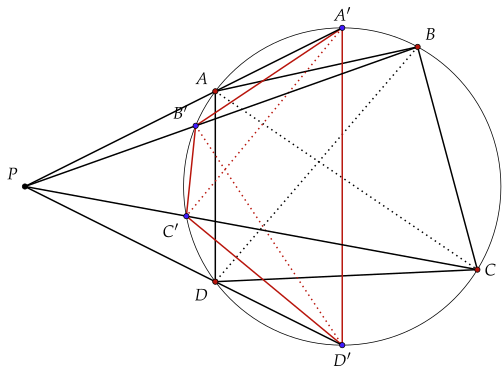
To prove this, we can use similar triangles. First, through simple angle chasing, it is evident that the following triangles are similar through AA similarity. \begin{align*} \triangle {PAC} &\sim \triangle {PC'A'} \\ \triangle {PDB} &\sim \triangle {PB'D'} \\ \triangle {PAD} &\sim \triangle {PD'A'} \\ \triangle {PB'C'} &\sim \triangle {PCB} \end{align*}
Using the length ratio of the similar triangles, we obtain following equations. \begin{align*} \frac {AC}{A'C'} &= \frac {PA}{PC'} = \frac {PC}{PA'} \\ \frac {BD}{B'D'} &= \frac {PD}{PB'} = \frac {PB}{PD'} \\ \frac {A'D'}{AD} &= \frac {PD'}{PA} = \frac {PA'}{PD} \\ \frac {B'C'}{BC} &= \frac {PB'}{PC} = \frac {PC'}{PB} \end{align*}
Multiplying the equations, \begin{align*} &\quad \ \frac {AC}{A'C'} \cdot \frac {BD}{B'D'} \cdot \frac {A'D'}{AD} \cdot \frac {B'C'}{BC} \\ &= \sqrt { \frac {PA}{PC'} \cdot \frac {PC}{PA'} \cdot \frac {PD}{PB'} \cdot \frac {PB}{PD'} \cdot \frac {PD'}{PA} \cdot \frac {PA'}{PD} \cdot \frac {PB'}{PC} \cdot \frac {PC'}{PB} } = 1 \end{align*}
is obtained with \(\frac {AC \cdot BD}{AD \cdot BC} = \frac {A'C' \cdot B'D'}{A'D' \cdot B'C'}\), and \((A, B; C, D) = (A', B'; C', D')\).
Before we wrap-up this section, consider the following theorem. This theorem comes especially handy when you have to draw a symmedian because many olympiads don’t allow protractor.
Theorem 1.1.2
Given a harmonic quadrilateral \(ABCD\), \(BD\) is the symmedian from \(B\) of \(\triangle {ABC}\).
Proof.
First, notice that by Theorem ??, it suffices to show that \(\frac {AK}{CK} = \frac {BA^2}{BC^2}\). Consider the following equations. \begin{align*} \frac {AK}{CK} &= \frac {[\triangle {ABD}}{[\triangle {BCD}]} = \frac { \frac {1}{2} AB \cdot AD \cdot \sin \angle {BAD} }{ \frac {1}{2} BC \cdot CD \cdot \sin \angle {BCD} } \\ &= \frac {AB \cdot AD}{BC \cdot CD} = \frac {AB}{BC} \cdot \frac {AB}{BC} = \frac {BA^2}{BC^2} \end{align*}
Therefore, the theorem holds.
With these concepts in mind, let’s discuss some fundamental theorems in projective geometry.