0.1 Geometry
Unlike other fields in math olympiad, I think geometry is the section that really need strong foundations with fundamental topics. Assuming that we are aware of basic topics like similar triangles, angle relationship between a tangent line and the inscribed triangle, the relationship between arc length and angle in a circle, and more foundational topics related to circles and points in triangles, let’s discuss some of the theorems that are necessary to understand future topics.
Also please note that this section is quite terse with less explanations and proofs. The latter section will prove the theorems because we need to memorize the proofs to actually use them in the exam, but the theorems mentioned here are considered common knowledge and generally not required to prove them. But please don’t quote me on this because it depends on the exams and countries. Also because I assume we are already familiar with the many of the topics here, let’s quickly go through them!
Theorem 0.1.1: Menelaus’ Theorem
Given a triangle \(ABC\), let the transversal line \(XY\) cut the triangle and intersect \(AC\) at \(Z\). The, the following equation holds. \[ \frac {BY}{YC} \cdot \frac {CZ}{ZA} \cdot \frac {AX}{XB} = 1 \]
Here is a diagram that manifests the theorem.
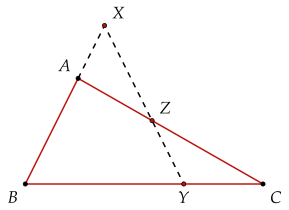
The equation can be quite hard to memorize as is, but when you think of it as starting from \(B\) and going around triangle \(ABC\) counterclockwise, it is very easy to memorize. Indeed, this theorem holds as long as you cycle through a constant direction from any points. We can also see that the following equations hold. \begin{align*} \frac {CY}{YB} \cdot \frac {BX}{XA} \cdot \frac {AZ}{ZC} &= 1 \\ \frac {AZ}{ZC} \cdot \frac {CY}{YB} \cdot \frac {BX}{XA} &= 1 \end{align*}
Menelaus is very important and it will be used quite a lot to prove important theorems like Pascal and Desargues, so its worth becoming more familiar with it! Also, the transversal line does not need to intersect triangle \(ABC\).
Continuing, here is Ceva’s Theorem.
Theorem 0.1.2: Ceva’s Theorem
Given a triangle \(ABC\), let \(X, Y, Z\) be points on lines \(BC, CA, AB\) respectively. The lines \(AX, BY, CZ\) are concurrent at \(P\) if and only if the following equation holds. \[ \frac {AZ}{ZB} \cdot \frac {BX}{XC} \cdot \frac {CY}{YA} = 1 \]
Here is the diagram that illustrates this theorem.
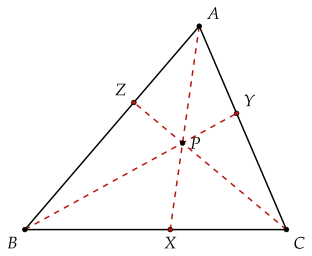
Here, the lines \(AX, BY, CZ\) are also known as cevians. Because this is also a very popular theorem and I assume we are somewhat familiar with this theorem, let’s move on to a slightly less popular form of this theorem.
Continuing with Ceva’s standard form, there is also angle version. This is very popular in Korea and we have a special name for it as well, but for some reason, I don’t think this is very well known internationally. Some sources call this as Trigonometric Form of Ceva’s Theorem, but let’s call it as Angle Form of Ceva’s Theorem because that’s easier to pronounce.
Corollary 0.1.3: Angle Form of Ceva’s Theorem
Given a triangle \(ABC\), let \(X, Y, Z\) be points on lines \(BC, CA, AB\) respectively. The lines \(AX, BY, CZ\) are concurrent at \(P\) if and only if the following equation holds. \[ \frac {\sin (\angle {BAX})}{\sin (\angle {CAX})} \cdot \frac {\sin (\angle {CBY})}{\sin (\angle {ABY})} \cdot \frac {\sin (\angle {ACZ})}{\sin (\angle {BCZ})} = 1 \]
This corollary powered with trigonometric identities can become very powerful. Future notes includes some of its applications in different topics like isogonal conjugate. Generally I think we do need to show this corollary during exams, but I think it is pretty self evident considering area of the triangles. Next up we have Ptolemy’s Theorem!
Theorem 0.1.4: Ptolemy’s Theorem
Given a cyclic quadrilateral \(ABCD\), the following equation holds. \[ AC \cdot BD = AB \cdot DC + BC \cdot DA \]
I personally have not seen many application of Ptolemy’s Theorem for KMO, but I think it appears quite often in KJMO. This is pretty much it for the theorem and I think because most of us are aware of this theorem, let’s review our final theorem.
Theorem 0.1.5: Apollonius’ Theorem
Given a triangle \(ABC\) with midpoint \(M\) of \(BC\), the following equation holds. \[ AB^2 + AC^2 = 2(BM^2 + AM^2) \]
This has a special name, but it is just Stewart’s theorem applied to a midpoint \(M\).
This is it for this section! Here I listed some of the foundational topics that we must know before proceeding to latter notes, and although there wasn’t rigorous explanation with examples for each theorem, I hope it was a good reminder of some of the topics! As mentioned previously, olympiad geometry requires lots of background knowledge to solve problems, and these are only the surface of them. But before we move on to more exciting topics, let’s review some of the topics form Number Theory as well.