0.1 Isogonal Conjugate
The isogonal conjugate of a point \(P\) with respect to a triangle is an interesting well-defined point that can be expanded to different techniques and patterns. Although the name suggests the definition of the point, here is the definition.
Definition 0.1.1
The isogonal conjugate of a point \(P\) with respect to a triangle \(ABC\) is the intersection of the reflections of \(AP, BP, CP\) with respect to the angle bisectors at \(A\), \(B\), and \(C\).
To better understand this topic, consider the following diagram.
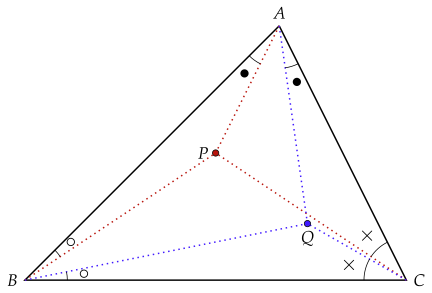
Note that the lines \(AQ, BQ, CQ\) are the isogonal lines of \(AP, BP, CP\) respectively. The point \(Q\) is the isogonal conjugate of \(P\) with respect to \(\triangle {ABC}\). Now this point \(Q\) is well-defined. To show that the isogonal conjugate is always a well-defined point, we can use many different methods, but here are two of my favorite ones.
For the first proof, we will use Angle-Ceva Theorem. I honestly am not sure the standard term for the theorem because it is not widely known, but in Korea we call it as Angle-Ceva Theorem and I also saw some English forms like the angle form of Ceva’ Theorem and trigonometric form of Ceva’s Theorem.
The theorem states that the following equation holds for some point \(P\) in triangle \(ABC\). \[ \frac {\sin \angle {ABP}}{\sin \angle {PBC}} \cdot \frac {\sin \angle {CAP}}{\sin \angle {PAB}} \cdot \frac {\sin \angle {BCP}}{\sin \angle {PCA}} = 1 \]
Note that by construction, the following equation holds. \begin{align*} &\quad \ \frac {\sin \angle {CBQ}}{\sin \angle {QBA}} \cdot \frac {\sin \angle {ACQ}}{\sin \angle {QCB}} \cdot \frac {\sin \angle {BAQ}}{\sin \angle {QAC}} \\ &= \frac {\sin \angle {ABP}}{\sin \angle {PBC}} \cdot \frac {\sin \angle {BCP}}{\sin \angle {PCA}} \cdot \frac {\sin \angle {CAP}}{\sin \angle {PAB}} = 1 \end{align*}
Therefore by reverse Angle-Ceva, \(Q\) is well-defined.
Another way of proving the existence is by using reflections.
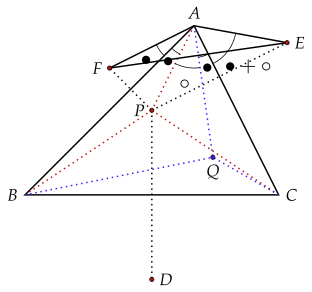
Because we do not yet know if there exists point \(Q\), let \(l_A, l_B, l_C\) be the respective isogonal lines. Notice that by construction, because \(AF = AP = AE\), \(l_A\) is the perpendicular bisector of \(FE\). Analogously, it is self-evident that \(l_B\) and \(l_C\) are perpendicular bisector of \(FD\) and \(ED\) respectively. In other words, the point of intersection of \(l_A, l_B, l_C\) is the center of the circumcircle of \(\triangle {DEF}\) and the center of such circle and the points \(D, E, F\) always exist. Thus, \(Q\) is well-defined.
I personally find this method more interesting because we can still prove it without prior knowledge. Continuing with the proofs, consider the following diagram for a special case.
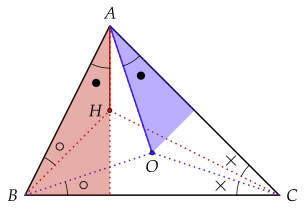
Notice that because \(\angle {AEF} = \angle {ABC}\), \(\angle {BAH} = \angle {OAC}\) by AA similarity. Similarly, the analogous argument applies to the other angles.
Points \(H\) and \(O\) are isogonal conjugates.
Before we wrap up this section, let’s discuss about a special case called symmedian.
Definition 0.1.2
The symmedian from a vertex of a triangle is the isogonal line of the line that passes through the vertex and the midpoint of its opposite side.
Consider the following the digram.
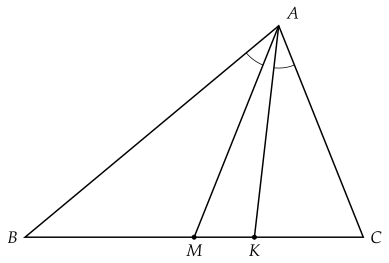
Here, \(M\) is the midpoint of side \(BC\) and \(AK\) is the symmedian from \(A\). With this definition, we can construct the following theorem.
Theorem 0.1.3
Given a triangle \(ABC\) with midpoint \(M\) of side \(BC\), \(AK\) is the symmedian if and only if \(\frac {CK}{BK} = \frac {AC^2}{AB^2}\).
Proof.
First, consider the following diagram where \(D, E\) are points on \(AB\) drawn perpendicularly from \(M\) and \(K\) and \(F, G\) are point on \(AC\) drawn perpendicularly from \(M\) and \(K\).
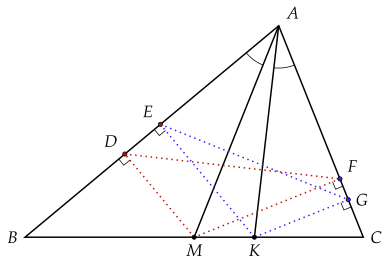
Notice that because \(\square {ADMF}\) and \(\square {AEKG}\) are cyclic, \(\angle {DMF} = \angle {EKG}\). Moreover by construction, because \(AK\) is the symmedian from \(A\), \(\angle {DFM} = \angle {KEG}\). Therefore, \(\triangle {DMF} \sim \triangle {GKE}\) and \(\frac {GK}{KE} = \frac {DM}{MF}\).
Continuing, notice that because \(\frac {1}{2} MD \cdot AB = \frac {1}{2} MF \cdot AC\), \(\frac {MD}{MG} = \frac {AC}{AB}\). In other words, \(\frac {GK}{KE} = \frac {AC}{AB}\) and \(\frac {[\triangle {AKC}]} {[\triangle {ABK}]} = \frac {AC^2}{AB^2}\). Moreover, because the entire process is reversible, the theorem holds.
The concept of isogonal conjugate appears surprisingly a lot when we discuss more advanced topics like harmonic range and spiral similarity. This is it for this section! Let’s discuss homothety in the next section before getting into exciting topics like harmonic range and spiral similarity.